Zine Local
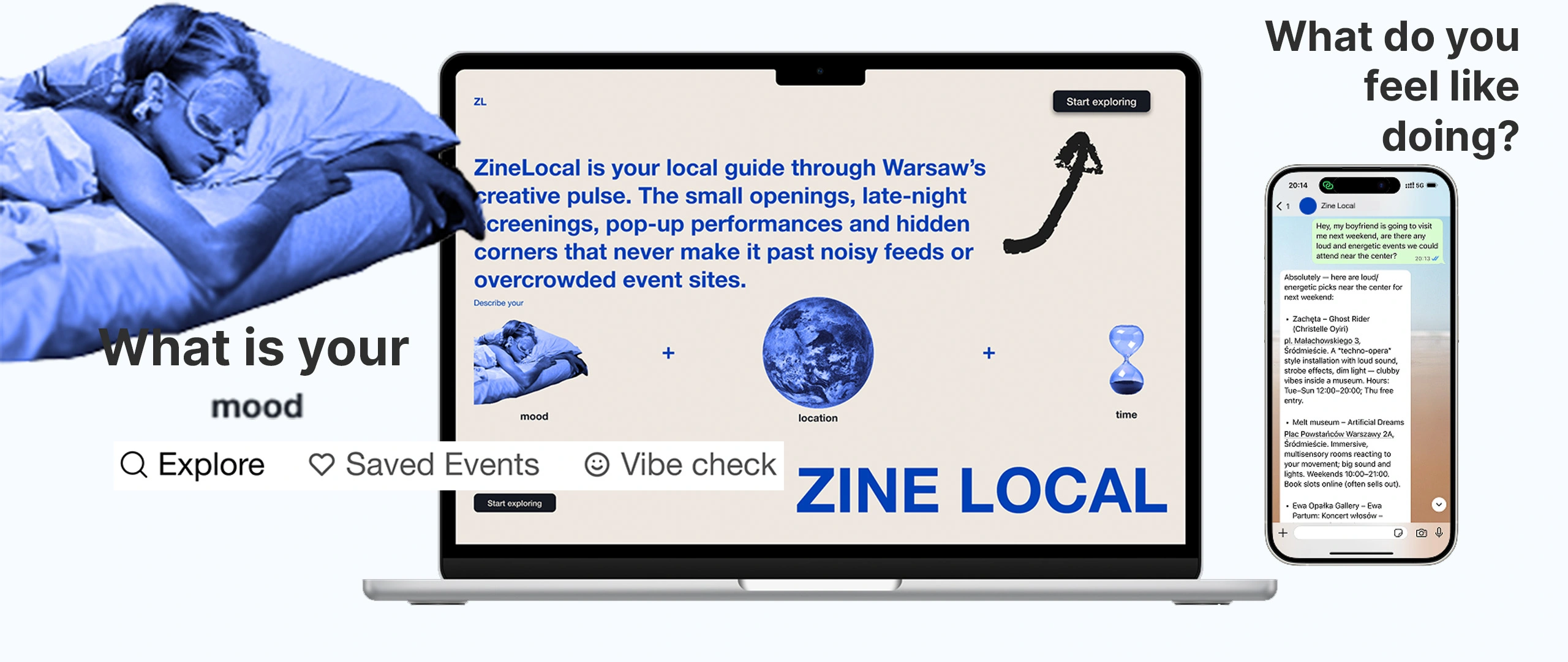
An AI-guided discovery tool built with Cursor, Cloudflare, and Supabase for vibe-based event recommendations.
- Role
- Designer
- Client
- Personal Project built as an application to AIR accelerator program
- Scope
- UX/UI, conversational flows, prototyping
- Stack
- Cursor, Cloudflare, Supabase, Figma
- When
- 2025
01Overview
Warsaw has a dense calendar of cultural events, but much of it lives on Instagram and Facebook.
If you do not live inside those feeds, finding well-curated experiences is surprisingly hard.
02Problem
Keyword search fails when you know how you feel—tired, curious, social—but not what genre or venue name to type.
I wanted to explore whether a conversational, vibe-led guide could feel like a knowledgeable local rather than another listings aggregator.
03Approach
I designed and prototyped Zine Local as a personal project—structuring mood inputs, preference capture, and curated results backed by a lightweight technical stack.
04Scope of work


05Challenges
Keywords vs. vibe input
Traditional filters assume users can name genres, venues, or dates upfront. Mood-based intent is fuzzy and changes mid-conversation.
→Lead with open prompts about mood and expectations, then narrow to curated lists—accepting ambiguity in input instead of forcing structured filters first.
Breadth vs. curated authenticity
Listing everything in Warsaw would feel noisy and untrustworthy. Too little coverage would make the guide feel empty or biased.
→Present smaller, opinionated sets of events per session—optimizing for relevance to stated vibe over exhaustive catalogs.
Bot personality vs. utility
A playful conversational tone could charm users—or slow them down if they just want a fast answer before heading out.
→Keep copy warm and local in tone but shorten paths to results after the first exchange—personality as framing, not friction.
06Outcome
We shipped a conversational prototype that returns curated lists from preference input—a base for exploring vibe-led search as a personal city tool.
The project clarified which questions earn useful answers, and where event data quality still limits recommendations.
07Reflection
I learned that discovery UX is emotional before it's informational—people describe days, not categories.
The interface has to honor that sequence, not fight it.
If I did it again
If I did it again, I would test with people who deliberately avoid social media, earlier—so edge cases in sourcing and trust show up before polishing UI states.